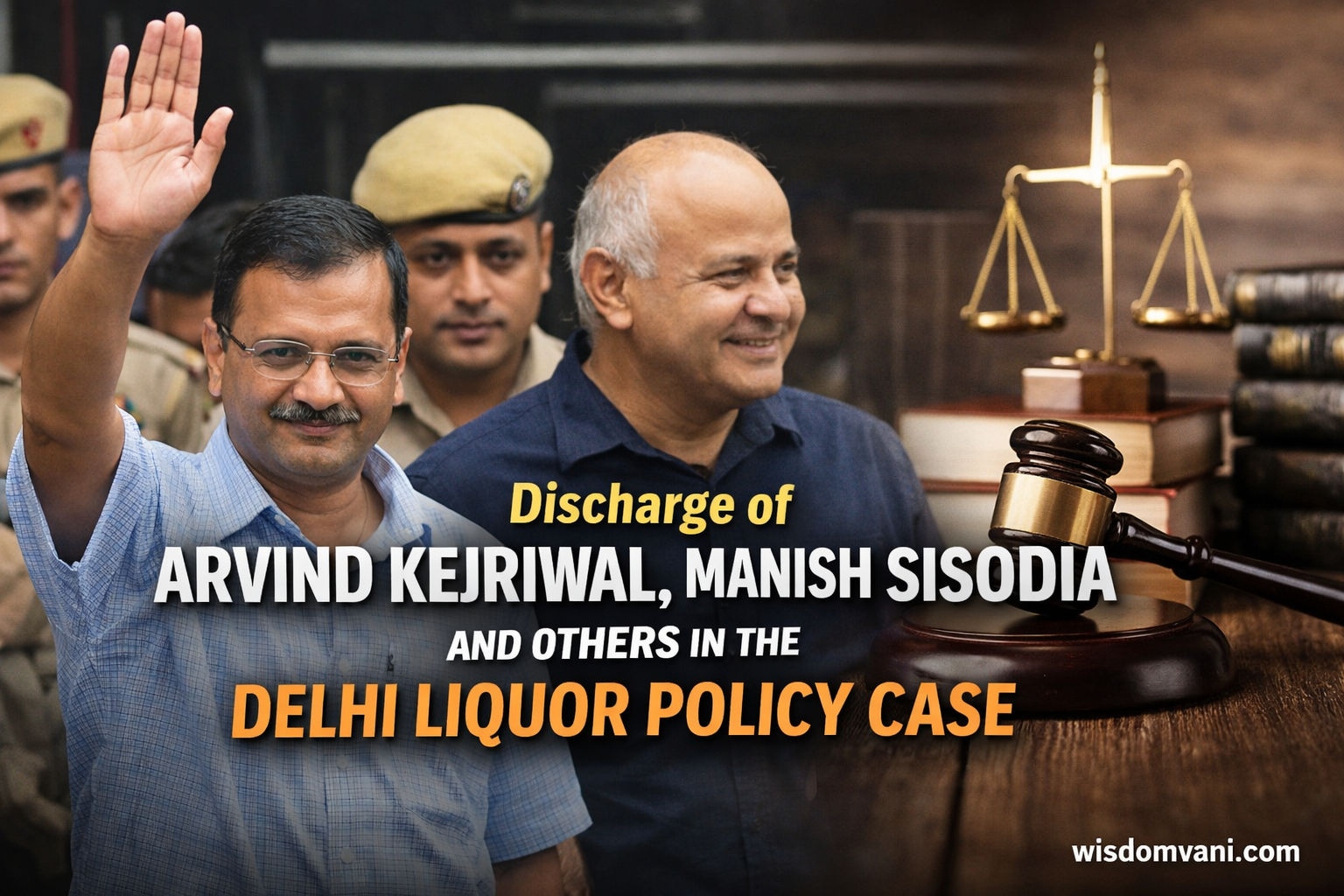
The judgment delivered on 27 February 2026 by Special Judge Jitendra Singh of the Rouse Avenue Court represents a watershed moment in Indian anti-corruption litigation. By discharging all 23 accused—including former Delhi Chief Minister Arvind Kejriwal, former Deputy Chief Minister Manish Sisodia, and Bharat Rashtra Samithi (BRS) leader K. Kavitha—the court effectively dismantled an investigation that had reshaped the political landscape of the National Capital Territory. The 598-page order characterizes the Central Bureau of Investigation’s (CBI) narrative as a "speculative construct" built on "conjecture and surmise," marking a rare instance where a trial court actively censured a federal agency for a "premeditated and choreographed" probe.
Administrative Context of the 2021–22 Excise Policy
The Delhi Excise Policy 2021–22 was introduced to modernize liquor retail and eliminate market leakages by transitioning to a fully privatized model. It shifted the city into 32 zones, with licenses auctioned to private operators and a fixed 12% wholesale profit margin.
The policy’s collapse was triggered in July 2022 by a report from Chief Secretary Naresh Kumar to Lieutenant Governor V.K. Saxena. The report alleged procedural irregularities and an estimated loss of ₹580 crore to the exchequer. Following these allegations, the CBI registered an FIR in August 2022, leading to the high-profile arrests of Manish Sisodia in February 2023 and Arvind Kejriwal in March 2024.
Legal Rationale for Discharge
Under Section 227 of the Code of Criminal Procedure (now the Bharatiya Nagarik Suraksha Sanhita), a judge must discharge the accused if no sufficient ground for proceeding exists.Special Judge Jitendra Singh ruled that the CBI’s case failed to meet even the "basic threshold" required for trial.
Lack of Prima Facie Evidence
The court found that the voluminous chargesheet, supported by multiple supplementary filings, suffered from internal contradictions that undermined the conspiracy theory. Regarding Arvind Kejriwal, the judge concluded he was implicated without "cogent material," noting that he was not named in the initial chargesheets and was only added in the fourth supplementary filing, which the defense described as a "cut-and-paste job".
Dismantling the Conspiracy Theory
The prosecution argued that the 12% wholesale margin was a deliberate "kickback-enabling" mechanism. However, the court found the policy was an "institutional deliberation" rather than a criminal plot. It noted a lack of a financial trail linking alleged ₹100 crore kickbacks to the policy's formulation. The judge observed that while the CBI claimed ₹44.45 crore was funneled to Goa for elections, these allegations rested on "inference and assumption" rather than legally sustainable material.
Constitutional Implications
The order underscored foundational constitutional principles regarding investigative power and individual liberty.
The "South Group" Critique
The court strongly castigated the CBI’s use of the term "South Group" to describe accused persons from Hyderabad. Judge Singh deemed the label "plainly arbitrary and unwarranted," noting it lacked statutory basis and was potentially prejudicial to Article 21 fair trial guarantees. The judge emphasized that criminal adjudication must rest on "conduct proved by evidence, not on who the accused is or where he comes from". To support this, he cited the U.S. case United States v. Cabrera (2000), where a conviction was set aside due to improper identity-based terminology.
Right to Fair Procedure
The judgment warned that allowing "approver statements" to fill evidentiary gaps could convert the exceptional mechanism of pardon into an instrument for narrative construction. The court highlighted that Manish Sisodia (530 days in custody) and Arvind Kejriwal (156 days) were subjected to a process that risked becoming "punitive" based on untested allegations.
Institutional Accountability: Inquiry Against the IO
In a rare judicial move, the court recommended a departmental inquiry against the CBI’s Investigating Officer (IO). This was primarily due to the framing of Kuldeep Singh, then Deputy Commissioner of Excise, as "accused number one" despite "absolutely no material" against him. The judge described the IO's conduct as a "calculated stratagem" to keep the narrative fluid by listing individuals simultaneously as suspects and prosecution witnesses.
Current Political and Social Landscape
The ruling arrived during the first-anniversary celebrations of the BJP-led Delhi government.
The Rekha Gupta Government
As of February 2026, Rekha Gupta serves as the Chief Minister of Delhi following the BJP's victory in the 2025 assembly elections. CM Gupta dismissed the discharge order as a "lower court decision," alleging that evidence had been "tampered with".She questioned why the AAP had withdrawn the policy immediately after the probe began and maintained that the people of Delhi had already delivered their verdict by voting the AAP out of power.
AAP’s Response
The Aam Aadmi Party hailed the ruling as a "moral victory" and a "clean chit". An emotional Arvind Kejriwal labeled the case the "biggest political conspiracy in Independent India" and dared Prime Minister Narendra Modi to hold fresh elections in Delhi, vowing to quit politics if the BJP won more than 10 seats.
Post-Judgment Legal Status
Immediately following the trial court’s order, the CBI moved the Delhi High Court to challenge the discharge. The agency contends the order is "legally perverse" and has sought a stay on the verdict alongside the expunction of adverse remarks against its officers. While the CBI case has concluded at the trial stage, the Enforcement Directorate (ED) has asserted that its parallel money-laundering investigation remains on a "different footing," though legal experts note that a discharge in the predicate offense may significantly impact the PMLA proceedings.
Conclusion
The 2026 discharge order reaffirms the necessity of legally sustainable evidence before subjecting citizens to criminal trials. By castigating the CBI's methods—from shifting approver narratives to arbitrary regional labeling—the court sent a resonant message about the salience of due process in a democracy. As the matter moves to the High Court, this case remains a touchstone for the intersection of criminal justice and political processes in India.

Comments 0